
Contract lookups are a 30-minute problem that nobody puts on the backlog. Most teams that deal with contracts and other legal documents regularly run into the same friction.
Someone needs to check a payment term, or confirm a renewal date before a client call, or look up a notice period so finance can close out an invoice. That means finding the right PDF, opening it, skimming through 40 pages of legal language and hoping it's the current version.
It takes 15 to 30 minutes, and it happens dozens of times a week across operations, finance, customer success and legal.
It's the kind of problem that never makes it onto a roadmap — it just gets absorbed. We wanted to see if we could solve it. Here's what we built and what we learned along the way.
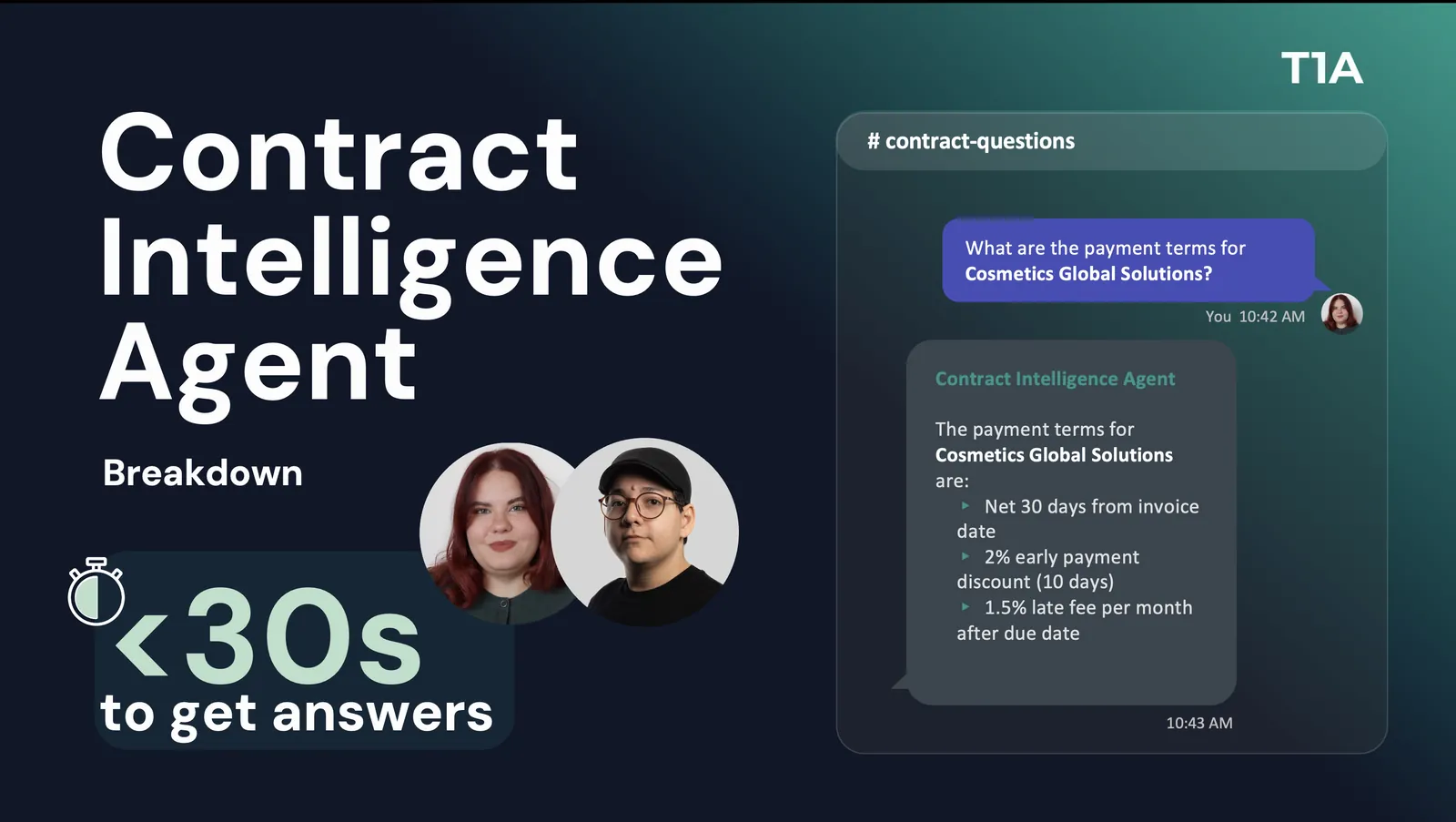
We built a Contract Intelligence Agent — an AI assistant that sits inside Microsoft Teams (or your preferred messenger) and answers natural-language questions about your contracts.
The answers don't come from general knowledge about contract law or the internet — they're pulled directly from your actual agreements, the signed and current versions.
If you ask "What are the payment terms for Northern Telecom Solutions?", you get an answer in about 8 seconds, with the relevant clause identified and referenced.
The experience is close to messaging a colleague who has read every contract in the company and remembers all of them — except you're not pulling someone out of focused work to ask.
Single lookups were where we started, but the agent handles more involved queries too.
You can ask it to compare multiple agreements — say, to surface differences in pricing structures across multiple clients, or flag where one contract uses fixed terms and another is time-and-material. If the answer comes back too detailed, you just ask for a shorter version.
The part that also matters for enterprise readiness was what the agent won't do.
We built access control into the retrieval layer. There's a list of allowed question categories, and before any vector search runs, the system classifies the incoming query against it. If it doesn't match — say someone asks for personal details — the request gets rejected before the contract content is ever retrieved.
We placed that boundary early in the pipeline on purpose. It doesn't rely on the language model behaving well. It's auditable, it's testable, and it scales without needing more people as the contract base grows.
The agent first resolves your query to the correct client record, even if you don't type the exact legal entity name. It then identifies the active contract and narrows the search to the relevant clause category — payment terms, dates, termination, whatever fits.
Vector search retrieves the two or three most relevant chunks from that contract, and those chunks plus your question go to a language model that composes the answer.
It's worth noting that this is semantic search, not keyword matching. So a question about "payment schedule" will still find clauses that use "invoicing terms" or "billing cycle."
Going from 30 minutes to 8 seconds is obviously useful. But what we found more interesting was what changes when contract knowledge is accessible to everyone, not just the one or two people who happen to know the details.
Before, an account manager preparing for a renewal would email legal and wait a day. Finance processing invoices would Slack the ops lead who set up the original agreement. A new hire inheriting 30 clients would spend their first week just trying to read through everything.
Now they ask the agent. The information was always there in the contracts, it just wasn't easy to get to.
That also means the person who used to be the go-to for every contract question gets that time back. They can focus on negotiation strategy, risk assessment and the work that needs their experience.
This is one example of the kind of small automation that's easy to overlook. The problem feels too minor to prioritise, the workaround is just "someone goes and checks," and so it stays that way. But those small frictions add up — and in most cases, a focused agent can handle them in a few weeks.
We've been building more of these recently, both internally and for clients. If you're curious about what that looks like in practice, we'll be sharing more soon. And if you want to look at your own processes in the meantime — chances are there's something similar sitting there, too small for the roadmap but costing more than it should.