
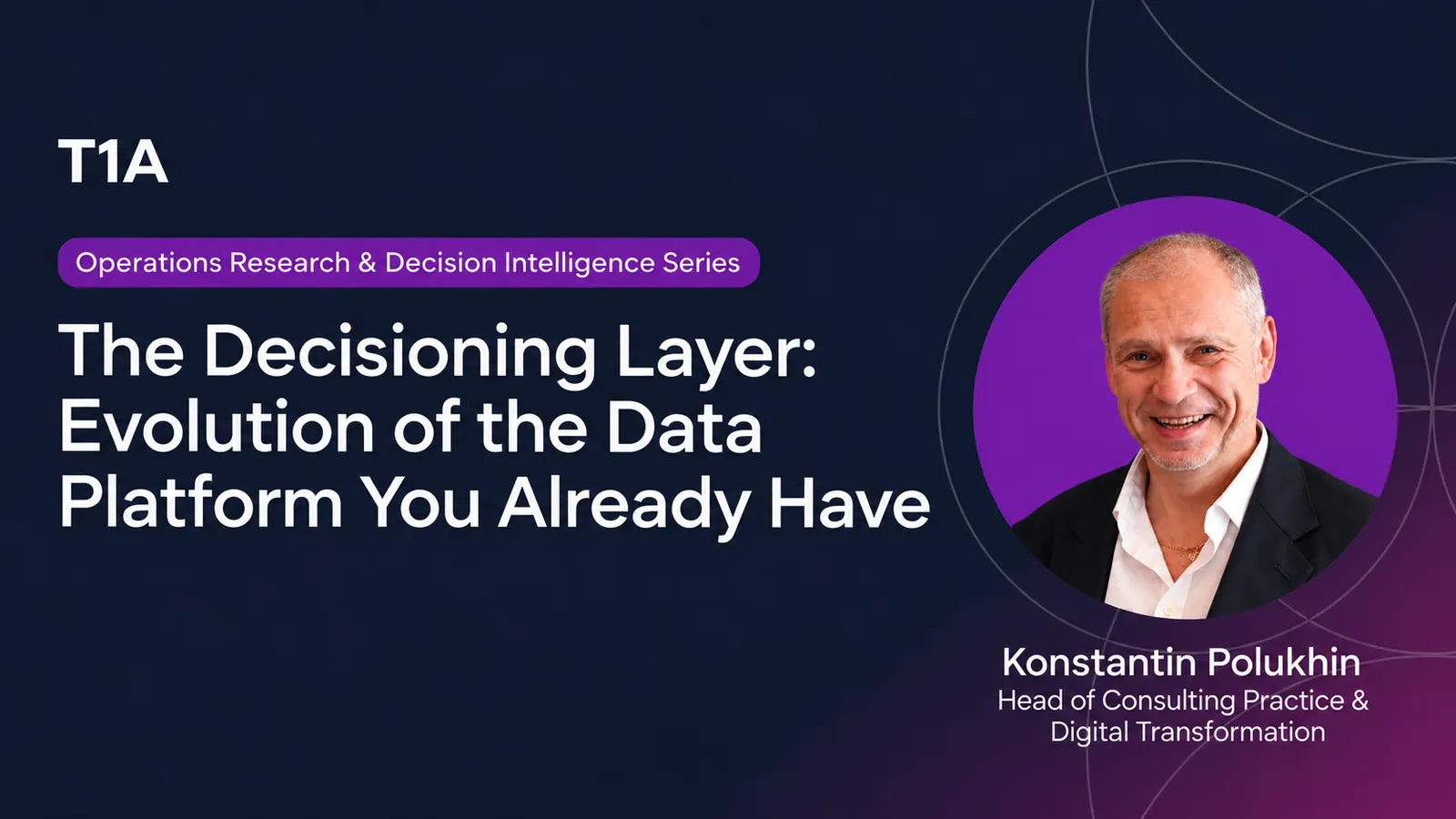
Part 1 of this series named the gap between analytics and action, and clarified that OR/DI and LLMs are distinct, complementary tools: one generates plausible content, the other computes provably best decisions. This piece answers the natural next question: where does this decisioning capability actually live? The answer is reassuring for anyone worried about a rebuild: it’s not a new platform; it’s the next module on the one you already have.
A well-run analytics platform was never one application. It’s a data layer (the pipelines, warehouse, and governance that get data into a usable state) with capabilities added on top as they become needed: BI and reporting, machine learning, and more recently LLM/GenAI. Each of these was, at some point, “the new module” bolted onto an existing data layer rather than a reason to start over. A decisioning layer, built on OR/DI methods, is the next module in that same sequence, not a parallel platform competing for budget and attention.
In a mature stack, data flows upward through progressively more decision-relevant layers. Raw and integrated data feeds BI (descriptive: what happened) and ML/LLM models (predictive/generative: what’s likely, or what plausible content looks like). Today, in most organizations, the flow stops there: the output is a dashboard or a prediction, handed to a person to act on. The decisioning layer sits one step further: it takes predictions, forecasts, and business rules as inputs, and, using optimization, simulation, or decision-analysis methods depending on the problem, produces an executable decision: a schedule, a route, an allocation, a price. That decision then feeds into whatever system actually executes it (an ERP, a WMS, a dispatch tool).
Concretely: a failure-probability model (ML) scores assets as high or low risk. Handed directly to a planner, that score is still just information. Routed instead into a decisioning layer that also knows crew availability, parts inventory, and regulatory outage windows, it becomes a maintenance schedule: output a person or a downstream system can execute directly.
Once a decisioning layer exists, the platform stops being a collection of tools that inform humans and starts including at least one component that recommends, and, where appropriate, executes, actions directly, under explicit constraints, with a measurable objective. That shift, small as it sounds architecturally, is what actually closes the analytics-to-action gap named in Part 1: the missing step is no longer missing, it’s a module like any other, sitting downstream of BI and ML/LLM and upstream of execution.
The next article in this series extends this picture across time: how connecting a decisioning layer across an enterprise’s operational, tactical, and strategic planning horizons turns this architecture into a closed-loop operating model, one that senses, decides, and recalibrates continuously, rather than producing a one-time recommendation.