
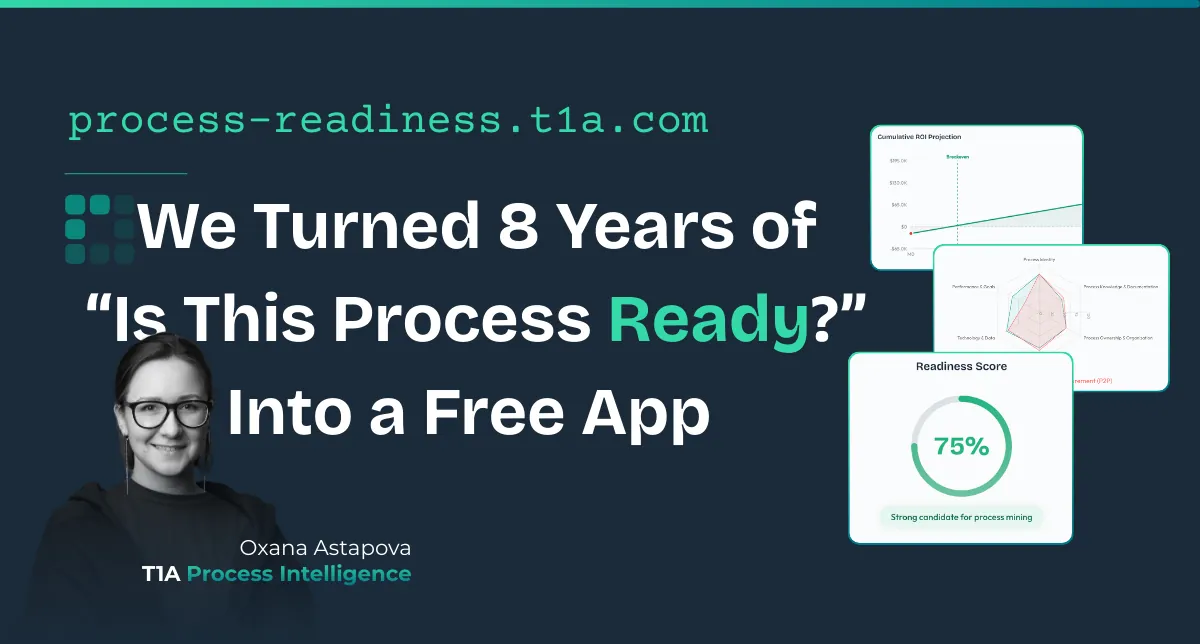
We made a free app for assessing process mining readiness: process-readiness.t1a.com It helps you structure what you know about a process, evaluate how ready it is for process mining, compare several candidate processes side by side, and do a quick ROI sanity check. No login, no backend — everything stays in your browser. Built on a methodology we've been using internally for years. If that's all you needed — go try it, we'll be happy.
If you're curious where this came from and why we built it — read on.
One of the most expensive lessons in process mining is starting a project with a process that isn't ready for it.
We've been there. Early on at T1A, we'd get into a project, start digging — and discover halfway through that the event data doesn't exist, or the process has no clear owner, or what the client calls "a process" is actually five different workflows duct-taped together. Not fun. Definitely not cheap.
Over time, we got better at checking the important things upfront. Not just the "go or no-go" questions — does someone own this process, is there a system that logs what happens, are there resources to act on findings — but also the technical picture that shapes the project scope. How many systems are involved? Are data exports configured? What's the actual volume and complexity? It's one thing to decide a process is worth analysing. It's another to plan that analysis realistically — and for that you need the full picture in one place, not scattered across people's heads and random documentation.
This turned into a proper practice. What started as a mental checklist grew into structured questionnaires, scoring templates, what we call a "process passport" — a standardised way to capture everything you need to know about a process before you decide what to do with it.
For years, this lived in Excel files and internal docs. It worked. Not glamorous, but it worked.
The interesting part — it's not always about process mining. Sometimes a client comes to us convinced they need process mining, and after going through the assessment it turns out the real first step is setting up proper logging, or building basic reporting that makes the obvious problems visible. Process mining is powerful when applied to the right situation. When it's not the right situation — and we've written about this before — you're better off knowing that early.
A month ago we ran a webinar on process mining and AI in manufacturing (by the way you can check it out here: https://t1a.com/resources/manufacturing-optimization-with-process-mining-ai-agents). We always want attendees to walk away with something they can actually apply to their own work — not just slides to forget about. So we wanted to share part of the methodology we use internally.
The original plan was simple: send our Excel templates to the attendees. Then we thought — if we're sharing this anyway, let's at least make it convenient. Give it a proper UX, make it something people would actually find helpful.
So we wrapped the methodology into a small browser-based application. Nothing revolutionary: a structured questionnaire across 6 dimensions, a scoring engine, the ability to compare multiple processes side by side, and a basic ROI calculator. We added some hints and pre-filled suggestions for common process mining processes (O2C, P2P, and the like) to make the quick assessment even quicker.
You pick a process, answer 32 questions grouped into six areas: process identity, documentation and knowledge, ownership, scale and complexity, technology and data, performance goals. The app scores each dimension and gives you an overall readiness level — plus specific recommendations for the areas that score low.
If you have several processes in mind and need to pick one for a pilot — try the compare mode. Assess them all, put them next to each other, and the answer usually becomes obvious. We do this regularly ourselves, and honestly — sometimes you don't even finish the full assessment before the picture is clear. Just the act of structuring and laying out the information does half the work.
There's also an ROI calculator — deliberately simple, no AI magic inside. Use it as a sanity check for whether a specific optimization idea makes financial sense, or play with the numbers to find the threshold — from what usage volume or up to what implementation cost does it even pay off on a reasonable horizon.
Everything runs in your browser. No backend, no login, no data leaves your machine. We built it this way on purpose — if you're assessing internal processes, the last thing you want is your data sitting on someone else's server.
The app is free and open to everyone: process-readiness.t1a.com
Let's be clear — this doesn't replace a proper discovery engagement. You can't pack everything we know about processes and projects into a questionnaire. But even in this form, it's a solid reality check. It helps you structure scattered information, spot gaps in what you know, and highlight weak points before they become expensive surprises.
This kind of assessment has always been part of how we prepare for projects — for presales, scoping, early discovery. The app didn't change what we do, it just made it more convenient. If it helps someone out there make a better-informed decision about their processes — whether they end up doing process mining or not — we're happy we shipped it.
Got a process you're not sure about? Give it a spin and tell us what you think — honestly curious how it lands outside our own bubble.
P.S. If you try it and something feels off or you have ideas for what would make it more useful — there's a feedback form right inside the app. We plan to keep improving it, and your input will shape what comes next.